
Feature
The World Reimagined: The Foundation for Physical AI – Why we invested in AVES Reality
Building simulation environments manually is slow and expensive. AVES Reality solves this by automatically generating physics-accurate digital twins from satellite data.
January 16, 2026
Category
Insights
Published
January 16, 2026
The industry consensus is clear: machines will increasingly navigate, reason about, and interact with the real world. What's less clear is how to validate these systems safely and at scale before deployment. Real-world testing alone cannot cover the rare edge cases that matter most sufficiently well – the sudden pedestrian, the unexpected obstacle, the plastic bag flying by because of wind. You need to test systematically, thousands of times over, before deployment. Whether you're validating an autonomous vehicle, training a defense system, or optimizing as mart city's traffic management, simulation is essential.
Why This Matters
The standard approach to building simulation environments is fragmented and slow and as a consequence, is difficult and expensive to scale. Engineers either build 3D environments by hand – hiring designers and engineers to manually model cities, street by street, intersection by intersection – or they deploy specialized vehicles equipped with expensive lidar and camera rigs to physically drive through streets and capture data. Both approaches are labor-intensive and time-consuming: the manual approach takes months and costs hundreds of thousands of euros per city, while the vehicle-based mapping approach requires coordinating expensive equipment and teams across multiple regions. Moreover, the resulting data often lacks semantic richness; you get detailed geometry but without the structured understanding of what each element actually represents (lane configurations, traffic rules, material properties) that the simulation stack needs. The synthetic approach, by contrast, is fast but has restricted value for validation because it doesn't reflect real-world constraints.
Industries such as automotive, defense or “smart city” have been trapped in this trade-off: fidelity or speed. You could not have both. AVES Reality solved exactly this trade-off.
Why AVES Reality
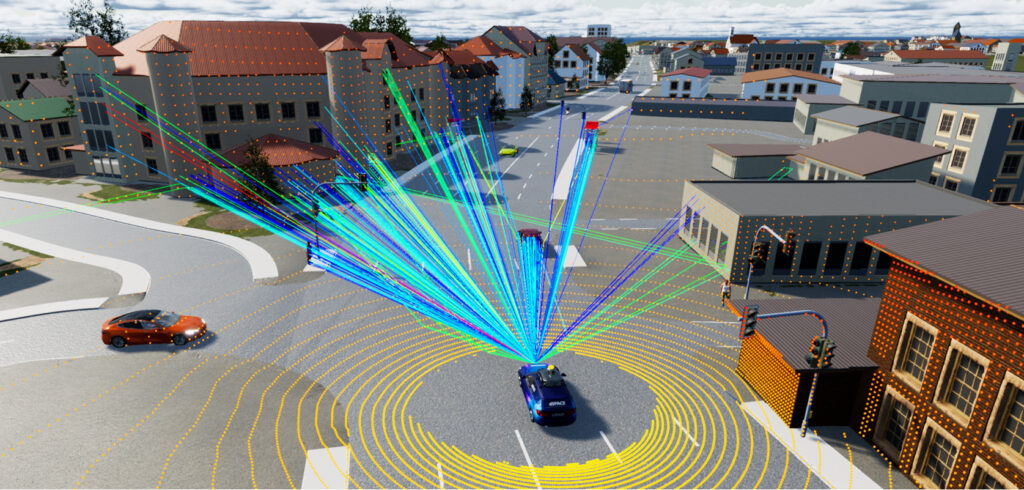
AVES Reality has built a software platform that automatically transforms raw satellite and aerial imagery into physics-aware 3D digital twins – semantically rich, simulation-ready environments of entire cities in minutes instead of months.
Here's what makes this different: most 3D mapping companies generate what looks like a video game world, visually passable but missing the mathematical rigor that machines need to learn, and not representative of the real world. AVES doesn't just create pixels in 3D space, it reconstructs the world with semantic labels baked in: every road knows its lane configuration and traffic rules; every building carries its height, material properties, and thermal characteristics; every surface is classified by type. The result is a digital twin that is not only realistic but physically accurate; a deterministic environment where a machine can be validated and proven safe before touching the real world.
The technical approach is elegant. AVES ingests satellite imagery, aerial data, and existing maps, then runs proprietary geospatial AI models to automatically detect roads, buildings, vegetation, and terrain. A custom 3D reconstruction engine assembles these elements into a coherent scene where everything is spatially consistent and semantically tagged. The whole process happens automatically. What used to require months of manual modeling now takes minutes.
The speed advantage is staggering: up to 900x faster than traditional approaches. But speed alone isn't the breakthrough. The breakthrough is that AVES's approach is scalable and repeatable. You don't need to hire new teams or wait for availability. You can generate a digital twin of any city on Earth where good satellite data exists, refresh it when the world changes, and scale globally.
This isn't theoretical. There are blue-chip customers validating that AVES solves a real, expensive problem in a way incumbents could not.
The team behind AVES,CEO Florian Albert, CTO Severin Knebel, and CPO Matthias Heger have done something remarkable: they've built a functional platform and secured substantial contracts with only €700,000 raised to date. That kind of capital efficiency is rare and suggests disciplined execution focused on solving customer problems from day one.
The partnerships amplify their reach. Collaborations with automotive engineering companies, simulation software providers, or companies like NVIDIA (whose Omniverse andCosmos platforms are becoming the go-to infrastructure for physical AI training) embed AVES's technology into existing workflows rather than asking customers to adopt something new.
The market tailwind is real and growing. Simulation for autonomous vehicles is essential: regulatory pressure for safety validation, the shift towards virtual testing as a prerequisite for real-world deployment, and the emergence of foundation models that need vast amounts of physics-grounded validation data. Beyond automotive, defense applications are accelerating: military training, sensor simulation, and mission planning all depend on accurate digital environments. Smart city initiatives are similarly driving demand, as cities worldwide invest in traffic management, infrastructure planning and AI-powered urban systems that require realistic digital replicas for testing and optimization before deployment.
What's Next
AVES Reality has raised €2.7 million in an oversubscribed seed round led by Matterwave Ventures, with participation from XISTA Science Ventures, xdeck, and Lightfield Equity, plus continued support from existing shareholders Bayern Kapital and Fraunhofer Technologie-Transfer Fonds (FTTF).
The path forward is clear. With these new funds in the bank, the team will accelerate its product roadmap. Advanced AI models are being developed to further automate map creation and push fidelity even higher, the integration with NVIDIA's world foundation models will further enhance the solution.
We believe AVES is building critical infrastructure for an industry in transition. Autonomous vehicles, smart cities, and physical AI systems all need accurate, scalable digital replicas of the real world, which positions the company at the foundation of how machines will come to understand and navigate the physical world.